

How to Get Back on Track When You’re Busy but Not Making Progress

A simple way to notice small signals, find the gap, and choose one useful move in the right direction.
My younger self would often notice small problems, and before I knew it, they had become bigger ones. I noticed this at work, and I noticed it in my personal life too.
I could be busy doing lots of things, but not necessarily the things that led to useful results.
A busy day would feel incomplete. A task might be pushed from one day to the next.
Something important might simply not be getting enough attention.
The problem wasn't effort. I was always doing plenty. The issue was not acting when signals suggested that something was slightly off. I was losing direction in different areas of my work and home life, and needed a way to head back in the right direction.
Step 1: Listen for the signals
What had made me notice the issue in the first place?
Was it frustration, delay, or avoidance?
Perhaps it was repetition, or the feeling that I was working hard but not moving the right thing forward.
The signal mattered because it gave me a starting point. It helped me move from a vague sense that something was wrong to a clearer sense of where to look. Somewhere I could focus my effort.
Step 2: Name the area
I would name the area the signal seemed to be coming from. That might be focus, tidiness, decision-making, health, or something else.
Naming the area helped because it stopped the problem from spreading everywhere.
Instead of thinking, “Everything is a mess,” I could begin to see that one particular area needed attention.
Step 3: Score the current state
Then I would give that area a simple score out of five for where it was now. The score was not meant to be scientific. It was just a way of making the current position visible. If my focus felt poor, I might score it as a two. If interruptions were too high, I might score that as a five.
Step 4: Score the future state
After that, I would ask where the area needed to be, and give that a score too. This was the future score. It did not have to be perfect. It only had to describe a more useful position. If focus was currently a two, perhaps it needed to be a four. If interruptions were currently a five, perhaps they needed to come down to a three.
Step 5: Notice the gap
The difference between the current and the future position is the gap.
A positive gap suggests that more of something may be useful.
A negative gap suggests that less of something may be useful.
The aim is to move the gap towards zero.
Step 6: Choose your first useful move
Once the gap was visible, the next step was to choose my first useful move. This was not about creating a complete plan or trying to fix everything at once. It was about choosing one small action that could nudge the area in the right direction.
Just enough to make a tiny difference, which could accumulate over time.
If I was busy all day but the important work was not moving, the first useful move might be to work on one important task for 20 minutes before opening email.
If the house kept feeling untidy by the evening, the first move might be to put away five visible things before dinner.
The value is not in the size of the action.
The value is in the direction it creates.
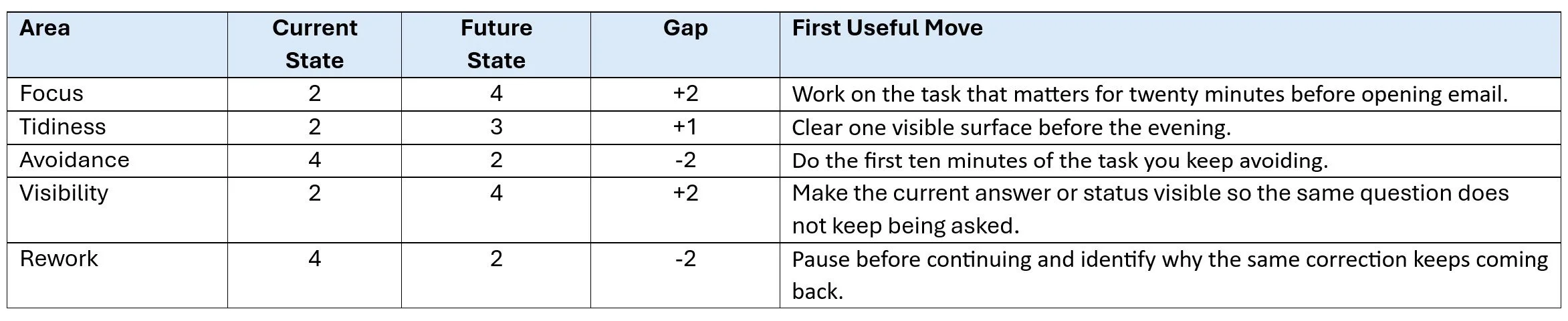
Simple gap analysis example
The table is deliberately simple. It is not full gap analysis, and it is not meant to replace proper analysis where proper analysis is needed.
Sometimes the first useful step is simply to notice that a gap exists. That is where this light technique helps. It gives enough structure to move from a small signal to a visible gap, and from a visible gap to a first useful move.
This is useful in personal life because many small problems do not feel urgent until they have become patterns. You keep meaning to start something, but never do. Rest gets squeezed. The house feels harder to manage. Important things remain in the background.
It is also useful at work because many team problems begin in the same way. Meetings lose clarity. Interruptions become normal. Handovers become weaker. Rework increases.
No single issue looks dramatic, but over time they add up and steal your direction.
This explains why effort is not turning into progress.
The aim is not to fix everything at once. The aim is to notice the signal, name the area it belongs to, see the gap clearly enough, and choose one useful move that points you in the right direction.
Without this, the signal stays vague. With it, you can begin to act before a small problem becomes a bigger one. It gives you a direction, and somewhere useful to focus your effort.
You write. You reflect. You return.