

What Testing Biscuits Taught Me About Reflection

Many years ago I worked as a business analyst. I loved the work because it required noticing things and contributing to decisions for the organisation. As a team we did some amazing work analysing the business, the corporate direction, where the gaps were and why they existed.
I don't recall exactly how it came about but we got into the habit of 'testing' biscuits from the supermarket during our lunch breaks. To avoid any confusion, I'm talking about British biscuits - or cookies, depending on where you live.
Being analysts, we were fairly adept at noticing things.
The flavour, the shape, the crunch, whether it was chocolate coated, dunkability - how well it survived being dunked in a hot drink, and so on.
So, as analysts do, we created a chart to log our test results.
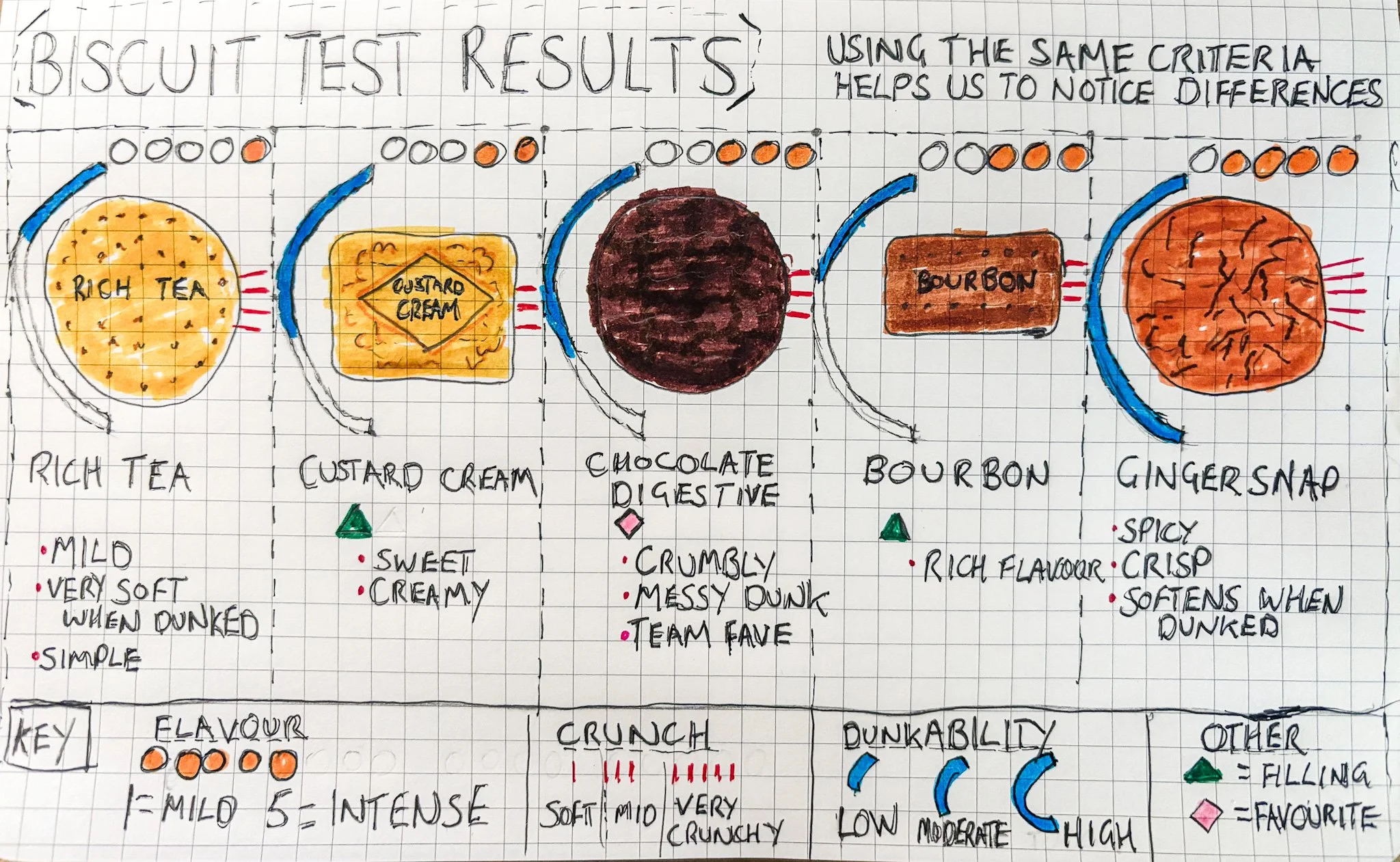
We didn't test all of the biscuits at once. Instead, we would buy one packet and share them with the team at lunchtime. There were some biscuits which required a second taste just to make sure nothing had been missed during the initial test!
I was thinking about this fun exercise recently and realised that having test criteria can help us to notice things, and noticing can help us to reflect.
The criteria didn't tell us what to think, the criteria told us what to consider.
Having something to notice can give us a starting point for reflection. We can reflect on our day, our life, our work or anything else we choose to reflect on.
When I reflect on my day, I make some simple observations to get me into a reflective frame of mind. I can note these. It takes about 30 seconds.
A memorable moment from the day.
Water intake.
Coffee intake.
Alcohol.
Chocolate.
Mood.
Sleep.
You might choose different things.
Choose things that are important to you, such as exercise, reading or even time outdoors.
By logging each day with the same criteria I can notice patterns over time.
One line per day.
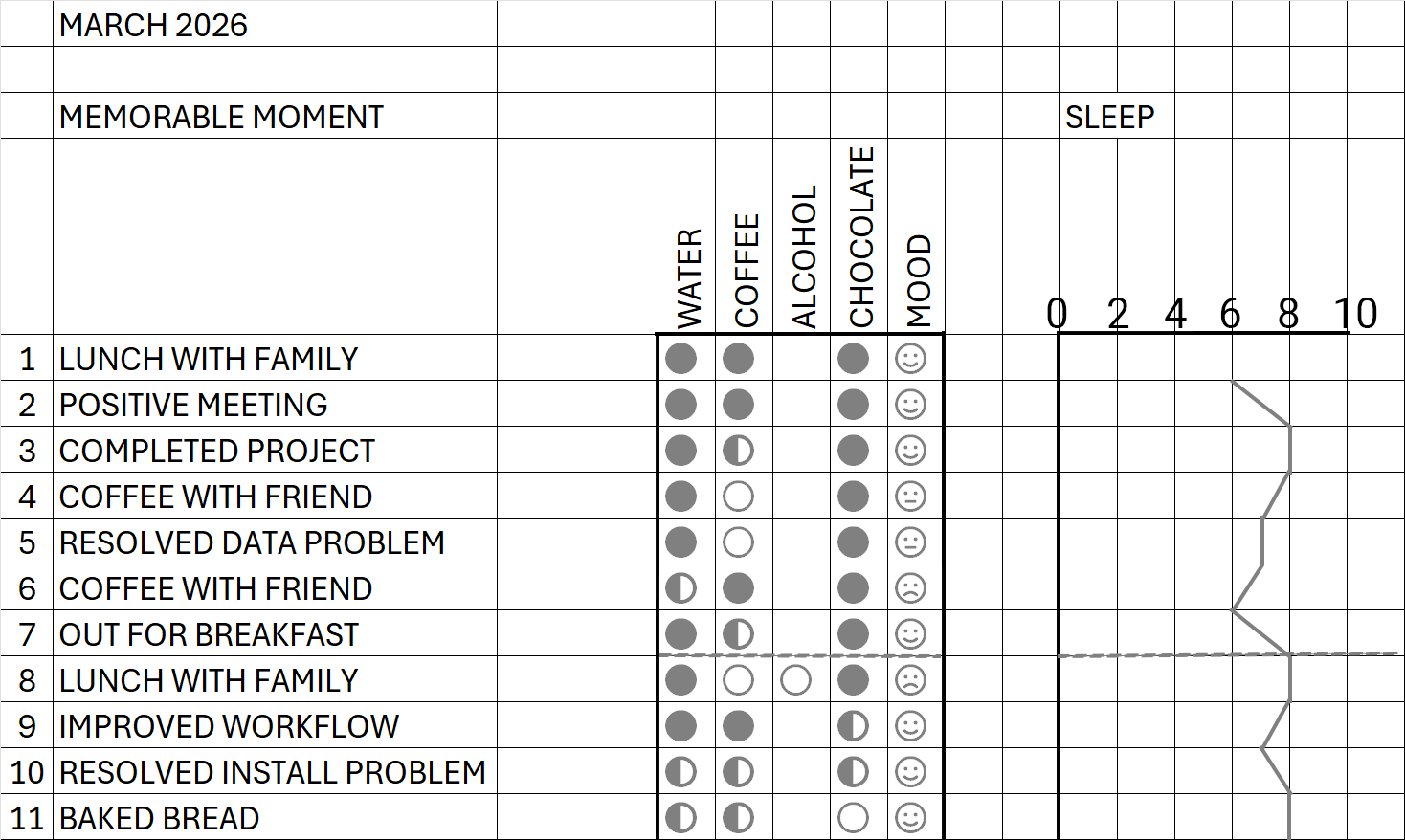
● = High | ◐ = Medium | ○ = Low | Blank = Nothing/Zero
These simple observations get me thinking about the day I've just had.
From there, I can ask some deeper questions.
What went well?
What didn't go so well?
What did I learn?
Could I explain what I learned to someone else?
What could I have done differently?
What would I change?
Taking the time to reflect on our experiences can help us to learn and improve our performance in the future.
Research by Giada Di Stefano, Francesca Gino, Gary Pisano and Bradley Staats found that people who spent time reflecting on what they had learned from an experience subsequently performed better than those who spent time gaining additional experience.
What we learn from reflection can inform what we choose to do next.
For the next week, try logging your day.
After a week, what do you notice?
If you can do it for a week, try it for a month.
Notice the patterns.
Build a habit of reflecting on your day.
Write. Reflect. Return
Reference
Di Stefano, G., Gino, F., Pisano, G. & Staats, B. (2014).
Learning by Thinking: How Reflection Aids Performance.
Harvard Business School Working Paper 14-093, 25 March 2014.