

When I reflect at the end of a day, I like to summarise it.
It takes less than a minute.
But I find it useful.
Through this simple daily practice, I begin to notice patterns.
I have something to take away from the day.
It’s personal, it helps me to notice and adjust my direction.
I keep it simple.
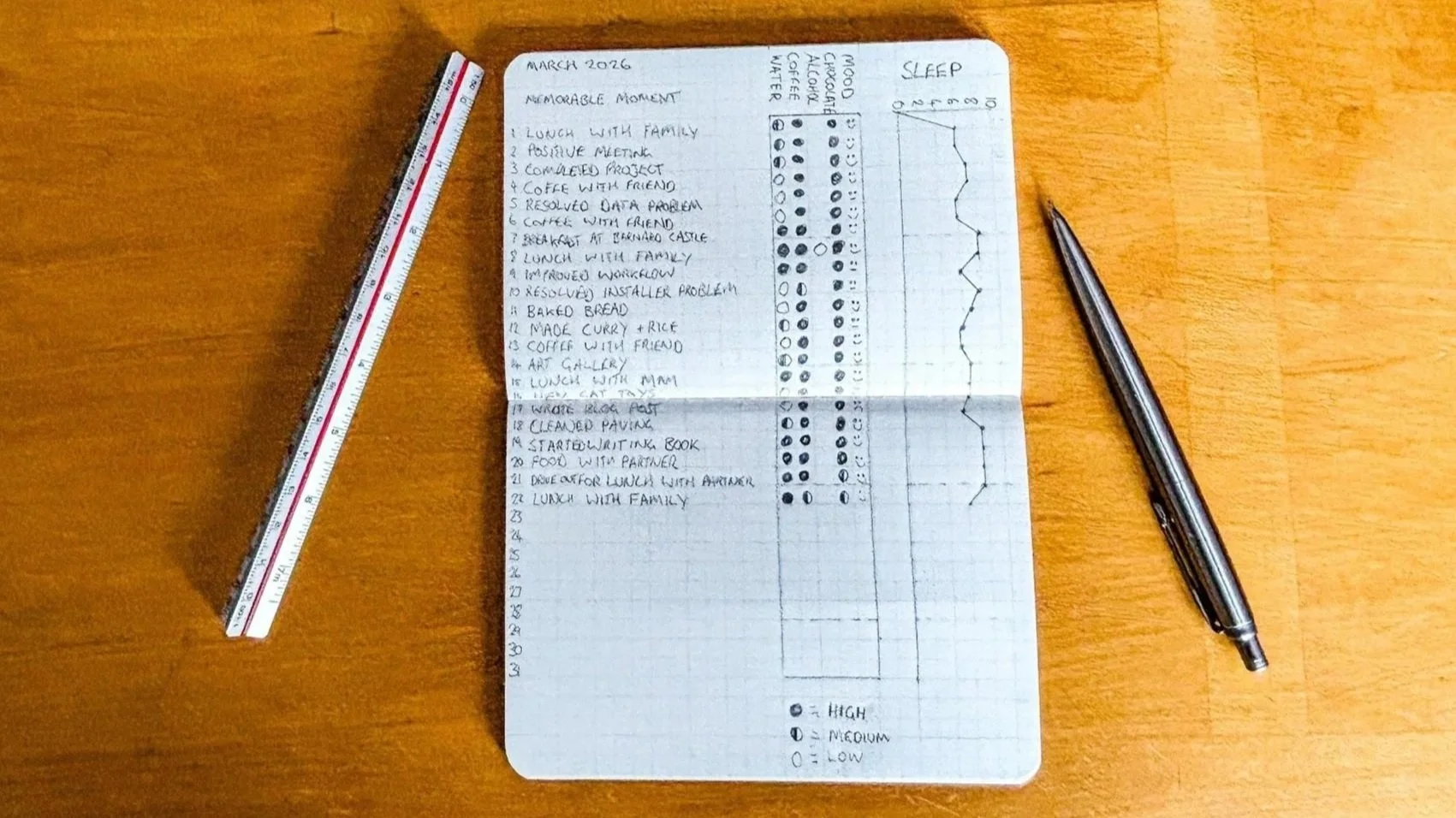
A squared notebook, turned sideways, or across two pages if it gives you more room.
At the top, the month and year.
Below that, one line per day about what was memorable or worth noting.
A short summary. Nothing detailed. Just enough to remember what stood out.
A memorable moment. Something enjoyable. Sometimes something I didn’t like.
Next to each day, I make a few marks.
A filled circle, a half circle, or an empty one.
Not precise tracking, but enough to make sense of the day.
Water. Coffee. Alcohol. Chocolate. Mood.
Just my choices, a mixture of good and honest.
That’s enough.
Sleep is the only thing I record as a number.
Just the hours.
I place a dot for each day.
At the end of the month, I join them and see how sleep relates to the other things I’ve noted.
Reading across each line gives me a view of the day.
Reading down the page gives me a view of the month.
Patterns begin to show themselves over time.
So how does this sit with an Eightly list?
Eightly is about focus.
This is about observation.
One helps you choose the day.
The other helps you see the days.
To break the month up, I add a light line every seven days.
To mark the weeks.
There’s no strict setup.
Keep it plain, or add colour or symbols if you want.
Use whatever works for you.
You can analyse anything.
But not everything needs analysing.
Choose things that matter to you.
Observe them over a period.
Work on the person you want to become.
You write.
You reflect.
You return.
Do what matters. Every day.